Wednesday, September 11, 2013

Carrot Cake with Apricots


My husband had a birthday fairly recently, but we were on vacation and I didn't have a chance to make his favorite cake.  So last night, we broke up our nightly salad routine and had cake for dinner.  We had some apricots in the freezer from the harvest at the local "pick-your-own" farm, and these added a nice color and flavor.  My husband had juiced earlier, and when I promised him cake, he saved a bowl of carrot pulp that would have normally gone into the compost.  This cake is made with nuts, and a generous slice is equal to a good-sized handful of almonds, macadamias and walnuts.  We have cut back on our nut consumption and are no longer eating nuts as frequently as when we first discovered raw food.  So for us this was fine as an occasional treat.  I did use honey for the frosting, but if you are vegan and do not eat honey, substitute with your favorite sweetener.  This cake is not a diet food, but it's much better for you than the alternative.

Carrot Cake with Apricots (Raw and Plant Based)

 Cake:

1 cup dates
1 cup dried apricots
1 1/4 cups apricots with juice, frozen and thawed, or about 1 cup of fresh apricot puree
2 tsp ground cinnamon
1 tsp ground nutmeg
1 tsp ground ginger  (next time I want to try grated fresh ginger)
1/2 tsp sea salt
6-8 cups carrot pulp
1 cup almond flour


Frosting:

1 1/2 cups macadamia nuts, soaked and drained
Juice of one lemon
1/2 of one vanilla bean
2 tablespoons honey or sweetener of your choice
20 drops of orange flavored stevia (I used SweetLeaf)
pinch of sea salt
up to one cup of water

Garnish:

1/2 cup walnuts, (optional)

For the cake:  Pulse the first 7 ingredients in a food processor until well-combined.  If you do not have a food processor, chop the dates and dried apricots finely, then mix in the remaining ingredients, using a fork to mash and break the thawed apricots down.

Place the mixture in a large bowl and begin stirring in carrot pulp.  You want enough carrot pulp that the mixture is not too wet, but no so much that the mixture doesn't hold together.  The type of juicer you have may make a difference in the amount of carrot pulp you'll use.  Drier carrot pulp is less dense so you can use more of it.  Just keep stirring it in until it starts to remind you of carrot cake.  Next, stir in the almond flour until well combined.

(Notes:  If you don't have a juicer, you can substitute with grated carrot.  Grated carrot is more dense than carrot pulp, and you'll need about half as much.  You may need to increase the amount of almond flour to compensate for the moisture in the grated carrot.  You can buy almond flour, or you can make it.  I placed raw almonds in the dry container of a high speed blender and ground them finely.  It took about 20 seconds.  Alternately, you can dehydrate the leftover pulp from making nut milk.  Ideally, the nuts should be soaked for 8 hours, rinsed, and dehydrated prior to grinding.)

For the frosting:  Place all of the ingredients except the water in a high speed blender. Blend, gradually adding enough water to achieve a frosting-like consistency.  Taste and adjust for sweetness.

To put it together:  I formed the cake mixture into a large ball, then placed the ball on a plate.  Using my hands, I formed the cake into a traditional round cake shape.  It was kind of fun, like making mud pies as a kid. 

Frost, sprinkle with walnuts, and serve!


We had some leftover frosting.  No worries.  I stirred in a capsule of pro-biotic and set it aside to make a delicious cream cheese-like spread for the raw bagels planned for a breakfast in a the near future!


Yes, this was dinner!

Many thanks to the following amazing bloggers for their carrot cake recipes that were the inspiration for this one.  They make life just a little sweeter.  In no particular order:

Chef Amber Shea's Enlightened Carrot Cake 

Emily von Euw's Raw Carrot Cake With Cashew Cream Cheese Frosting

Laura-Jane The Rawtarian's Raw Carrot Refrigerator Cake

Karen Knowler's Raw Carrot Cake

Russel James's Carrot & Orange Cake

Saturday, September 7, 2013

Black Forest Torte

Black Forest Torte


In July, I attended another of Chef Areeya's wonderful raw food prep classes.  The menu included Cucumber Melon Herbed Chiller, (soup), Sliced Tomato and Belgian Endive Salad with Basil Vinaigrette, Baby Swedish Neatballs for the appetizer, and Pasta Primavera with Spinach and Asparagus Alfredo for the main course.  The dessert was Black Forest Torte.

I took pictures, but unfortunately the camera malfunctioned and they were lost.  You'll have to trust me on this one.  It was delicious and raw, putting big smiles on all of our faces, like always.

I went home and made the Black Forest Torte.  Chef Areeya has given permission to share the recipe, so here it is:

Black Forest Torte

Cake/Crumble: 

1 cup pecans soaked and ground to medium-small pearl
1 cup almond flour or soaked almond puree
 1/2 cup cacao powder
1/3 cup agave nectar
1 tsp ground vanilla
pinch of salt

Massage nuts/flour with chocolate, sweetener, pinch of salt and vanilla beans then press into pie tin or individual containers.

Filling:

1 large bag of fresh or frozen organic black cherries
1/4 cup of desired sweetener (agave, honey or coconut crystals are all great)


Topping:

1 cup coconut cream (1 cup young Thai coconut flesh blended into a cream)

Press your crust mix into desired plan, layer with sweetened cherries and drizzle with coconut cream.  Simple, sweet and decadent.  Delish!

Notes:  This is also nice if some of the crumble is reserved and placed between two layers of cherries.  The Black Forest Torte in the photo was made by blending half of the cherries with chia seeds and allowing it to thicken, then stirring the remaining cherries in. I replaced the agave nectar in the crust with date paste, and used honey to sweeten the cherries.  I also added a bit of vanilla powder to the coconut cream, because that's how we like it.


Friday, July 19, 2013

A response to "The undeniable facts about the safety of Diet Coke"

Recently a friend shared this article on Facebook, and I found that I wanted to join the discussion, but comments were closed.  So I'll comment here.


Here's how the article strikes me:  Julie Neidlinger, the author of the blog post, was criticized by her friends for drinking Diet Coke, and it stung.  She pushed back with a blog post which went viral because it stirred up the food controversy.


I sat down at the table with friends, enjoying our get-together at the diner. The waitress took my order for a Diet Coke. She left. A friend spoke up.
“They say that Diet Coke increases your chance of getting diabetes by a factor of seven.”
“I heard people were getting seizures from the aspartame in it.”
“Today the news said a lady died after drinking 10 liters of Coke.”
“That’s nice. Enjoy your glass of city water filled with chemicals like fluoride,” I replied.
Are you kidding me?

First issue in the blog post that I would like to address:  Friends who tell friends what to eat and drink.  That's a tough one. Sometimes people are just uncouth.  Maybe they are socially inept and don't realize that they are uncouth.  We all have choices about what to eat, and we all also have choices about how we interact with people.

For example, when reacting to unsolicited dietary advice, we could choose to write what we really think in a blog and hope the offender reads it.  Or, we could say, "I appreciate your concern about my welfare, and I'll take your advice under consideration," then smile, look them directly in the eye, and take another big swig of Diet Coke followed by an exaggerated sigh of pleasure.  Or, we could call our friend on the phone and say, "Hey, can we talk?  Remember the other day when you told me that Diet Coke will give me cancer?  Well, it made me feel like I was being judged for my personal habits.  It made me feel pretty awful actually, so next time we go out to eat, can you please not lecture me about what I order?  Thanks!"

This last response might give the friend a chance to respond.  They might say, "I'm so sorry, I didn't mean to offend you.  It's just that I care about my friends, and I don't want them to get sick.  And I just started finding out about the toxins in our food, and I've become very passionate and vocal about it.  Next time we eat out, I'll try harder to be considerate of your feelings."

Personally I am thankful for the people who have "lectured" me about what I eat.  No, it didn't always feel good, and some of my friends have better social graces than others.  Sometimes I felt defensive.  I felt like saying that my health habits really aren't so bad.  Sometimes I resisted the urge to point out their flaws and see how they liked it.  I'm human.

Many of my friends, however, have such a high level of respect and grace, that rather than feeling demeaned when we talked about food choices, I felt enlightened and loved.  I wish I knew how they did that.  

Those little conversations rattled around in the back of my head, sometimes for years.  Then one day when I tried raw food and felt energized, nourished, and more alive than I had felt in a long time, I remembered all those comments.  Life experience has led me to the lifestyle choices I make today, but I couldn't have made those choices if I didn't know they existed in the first place.  So yeah, you "granola pushers" or whatever the heck we are calling you these days, bring it on!  I welcome you!  I embrace you!  If it wasn't for you, I'd still be eating Oscar Myer Wieners on Wonderbread and washing it down with red Kool-Aid and a Twinkie.  Okay, I'm exaggerating.  More likely, it would be a microwaved Lean Cuisine with a V-8 and a Centrum tablet, with me thinking I'm all healthy and wondering why it hurts to walk when I  get out of bed in the morning.

Recently, while waiting as my son participated in an event, another parent mentioned that he's a raw foodist.  I was ecstatic.  He was the first real-life raw foodist I've met outside of a raw food meetup or some type of transformational gathering.  What began as a enthusiastic conversation turned into a minefield as he began to tell me that I'm doing it wrong.  Apparently, green smoothies are bad for you because you can't eat fruits and vegetables at the same time.  I said I've been studying nutrition and trying to figure out the best way to get enough nutrition on raw food.  He said that's completely unnecessary - our ancestors didn't worry about what was in the wild foods they ate.  They just ate whatever was available.  I said something like, "How long did those people live?  How did they fight infection and disease?"  My impression is that they lived just long enough to reproduce, and generally not a whole lot longer.   Striving to find a happy note before changing the subject, I smiled and said something like, "There are lots of ways to be raw."  I'm convinced that the gentleman is a nice guy who is simply speaking his truth.  He was not trying to shame me into eating like he does.  I don't know whether he knows or cares how his comments make other people feel.  I'm sure that his approach alienates some people, and I chose to not take it personally.

Of course, it's natural to talk about food when people are eating.  And sometimes, when people are excited about something, like what they've recently learned about food and diet, it's hard to not share.  Trust me, I've made this mistake several times.  We can try to share thoughtfully or apologetically, but what do we do?  Talk about shoes?  Yes, changing the subject is always an option.  My point is that it can be very difficult to not talk about whatever we feel passionate about.  And there's a real risk that we might start talking about vegan shoes, and off we go again!

I am repulsed by the idolatry that my body is so precious that I must find something more healthy and pure, that these non-organic fruits lack enough nutritional value for the little god that is me.

Okay, on to the second point of the blog post that I'd like to address:  precious perfect purity princes and princesses.  These are the people who feel they must eat superior food because they are superior people.  I'm sure they must exist.  I have never met one that I am aware of, though.  Most of the people I know who try to eat better do so because they want to feel better.  Some eat organic food because they want to vote with their paycheck.  They believe, like I do, that everyone, rich and poor alike, has a right to enough high-quality organic food to eat.  And everyone could eat better food, if things were being run a bit differently.  They simply put their hard earned money toward what they wish to support.  It's not fair to accuse all of these people of narcissism.

If everyone decided to boycott Coca-Cola, the Coca Cola Corporation would have to figure out what they need to do to stay alive.  Like, perhaps, bottling a more healthful beverage.  Even the poor would benefit.

I can't always afford organic produce, but when I do buy it, I like to think that maybe someday it will be the norm instead of the exception, and everyone will be able to eat it regardless of income level.  However, that will never happen if local organic farmers aren't supported.  So thank you, all you buyers and growers of organic food.  Maybe you eat better than I do, but thank you, all the same.

When you donate food to the food pantry, do you donate the expensive organic carefully-sourced food that you insist is the only acceptable thing to put in your body and that you feed yourself and your family, or do you get the cheapest canned and boxed food at the store?

I would like to comment on the criticism of organic people donating non-organic food to food banks.  Applying Maslow's Hierarchy of Need to food insecurity, it makes sense that a person suffering from hunger will set aside concerns about things like pesticides and GMOs in food until they are in a better position.  I am grateful to those organic food eaters who donate non-organic food to food pantries.  They are doing what they can, and no one can judge their effort.  I am even more grateful to those who organize community gardens for people with food insecurity so that they can grow their own organic food.  And I have witnessed people donating organic food to food pantries. For all those who help the hungry and the food insecure in large ways and small, bless you.


Here's the thing that makes me angry:  Food insecurity isn't necessary.  There are enough resources to go around.  Here in Las Vegas, everywhere I look in the city I see landscaping.  What if the plants we cultivated for our walkways, schools and parks were fruit-bearing?  What if we created more community gardens?  What if it became a trend in Las Vegas to cultivate an edible landscape in one's front yard?  What if instead of a handful of local farms, we had ten times as many?

Someone might say that edible landscaping requires more water than desert landscaping, and that farms use a lot of water.  My response is that there are ways to garden which are more water-smart, and we already waste a lot of water here that can be better used for helping people.


I believe that it is a myth that we need the food processing industry to make low quality, highly preserved foods with a long shelf life, and the giant agricultural industry to create genetically modified seed and bathe livestock in antibiotics in order to "feed the world."  The myth is perpetuated by the industries to protect their interests.

Out of the fear industry, many things have developed. Like being afraid of our food.

Okay, on to the next point that grabbed my attention.  Fear and fear-mongering.  Fear that if one's child touches corn syrup, all is lost.  Yes, I know what you mean.  I agree, it's a problem.   There are fear mongers spreading nonsense about politics, religion, and civil rights.  Fear mongers say that legalizing marriage between gay people will threaten the institution of marriage.  Some fear mongers said that the price of food would go up with mandatory GMO labeling, which caused California citizens to vote against their interests (in my opinion,) and defeat Prop 37.  There are fear-mongers spreading exaggerations about the Standard American Diet, too.  However, I wouldn't characterize every person who is interested in avoiding processed, convenience and junk foods as a fear monger.   

Then there are people who are almost religious about what is in their food.  However, that's their right.  Instead of eating kosher, they eat "pure."  Are they motivated by fear?  Not necessarily. I believe that many of them are motivated by strong core beliefs.  Let's leave them alone.  After all it's a free country. 

Julie Neidlinger didn't mention outright paranoia, but it seems that exists too, right alongside fear mongering.  There exists out there somewhere a person who believes that the big chemical corporations put red dye in our food because they are in cahoots with the pharmaceutical industry.  They think we are deliberately being fed cancer-causing food so that we will be forced to take drugs to treat cancer. Or that we are being fed the SAD (Standard American Diet) to shorten our lifespans so the government doesn't have to pay out as much Social Security.  Before the memos from the tobacco corporations went public, I would have said that this was baloney.  Now, I don't know.  Honestly, I don't.  Maybe sometime in the future, memos from the agricultural, processed food, and pharmaceutical  industries will come out proving they've been intentionally creating food addictions and health problems.  In the meantime, I'll continue to try to do my best to eat for health, and try to educate people around me without making them feel badly.

I don’t know if you’ve ever bothered to talk to someone who’s really old and had to do some of that live-off-the-land stuff, but you ask them if they want to go back to doing things by hand and they, like my grandma told me once when I asked if she missed the “good old days”, are probably going to come out in favor of automatic dishwashers, cake mixes, and Crisco. It wasn’t an alt-lifestyle option, but the only option, and given modernity, they leapt for it.
It’s called progress, because it is.

Next point:  "Typhus wasn't much fun."  When I read that, I thought, "Huh?"  How can someone connect people who are trying to eat closer to the way our ancestors ate to a complete rejection of modern science?  The blogger writes,  "It’s easy to decry technology and its evils from your comfortable perch in the midst of it."

I think that may be where people started thinking the blogger was referring to GMOs.  She did say in the comments that she was not talking about GMOs, but  a common argument used in favor of GMOS is that a rejection of GMO produce equals a rejection of modern science.  Which of course is a completely fallacious argument.

Perhaps the blogger meant that a  rejection of modern food processing techniques and a rejection of the use of chemical flavoring and preservatives equals a rejection of modern science.  She mentioned people who want to go back to the land.  Here's my impression:  Generally speaking, people who are interested in simplifying their lives, eating whole food, and "going back to the land" are not interested in giving up wi-fi, cell phones, internet access, and trauma centers.  I've never met a raw foodist, whole foodist, or even a wild-food forager who demonizes science, but I have seen them protest some of the ways that science is used or has been used to harm people and the environment.  There are things like saccharin and Agent Orange. 

I think that eating closer to the way we evolved on this planet is actually a useful way to use science to improve human health.  After all, without science it would be more difficult to know for certain what and how our ancestors actually ate, or to measure the effects of diet on our health.

A movement toward environmentally friendly, natural foods and a review of what our ancestors ate and how they grew their food is not a rejection of progress.  It is progress.

Science could, in my opinion be used in better ways.  For example, what if we used science to help subsistence farmers in famine-stricken regions to improve their yields, reduce their labor,  improve sanitation and healthcare, without polluting the land, turning the population into a consumer base for large corporations, or creating an artificial dependence on aid?   To those scientists who are already doing this, a heartfelt thank you.


Finally, the blogger commented that what we put in our heads is just as important as what we put in our bodies.  Well yes, I tend to agree with that, except that I don't think that information about healthier food choices is the culprit here.

It seems to me that there is a general tendency within certain industries to try to keep consumers in the dark about certain things that they buy.  Or even to keep them in the dark about certain things they buy into.  Otherwise, journalists would be allowed to bring cameras into slaughterhouses.  The fact that consumers are sharing information amongst themselves tells me that some people want to know the truth so that they can make informed decisions.  Yes, there is plenty of half truth and misinformation going around, but it isn't just coming from one stereotypical group.

I think that there is much at stake for the giant food processing industries and agribusiness conglomerates.  They benefit from articles that tell people that there is nothing wrong with the SAD (Standard American Diet.)  I think we need to think about the agenda of the authors of the pro-SAD media.  Further, it's important to be responsible about what one puts in other people's heads.  It's important to write according to one's conscience.  It's also important to discuss it.  So, next time someone tells me that something that I'm eating is bad for me, rather than object, I plan to welcome the dialogue and thank them for sharing their thoughts.

I think we need to keep the conversation going.

Saturday, July 13, 2013

Go Raw Café and Juice Bar

Here in Las Vegas, Nevada, we are fortunate to have a handful of options for dining out on delicious raw food.  The Go Raw Café and Juice Bar Eastside and Westside are two of these.  The Go Raw Café and Juice Bar restaurants are happy, laid back, positive places to dine and meet up with friends. There are other raw food establishments in Las Vegas, they are terrific and we love all of them, but in my opinion the two Go Raw locations are the best places around for a total raw food experience.  My husband and I like to eat there with the kids, and I like to enjoy the classes and events that they offer.

A few weeks ago, Chef Areeya gave another one of her wonderful Go Raw Prep Classes at the Go Raw Café Westside.  At each class, Chef Areeya spices up her food prep tricks and secrets with entertaining stories and anecdotes. I always leave uplifted, inspired and ready to create a new raw meal for my family.


Chef Areeya shares some raw food wisdom

Those attending the class try each dish as Chef Areeya demonstrates how it's made.

A platter of the salad from the raw food prep class

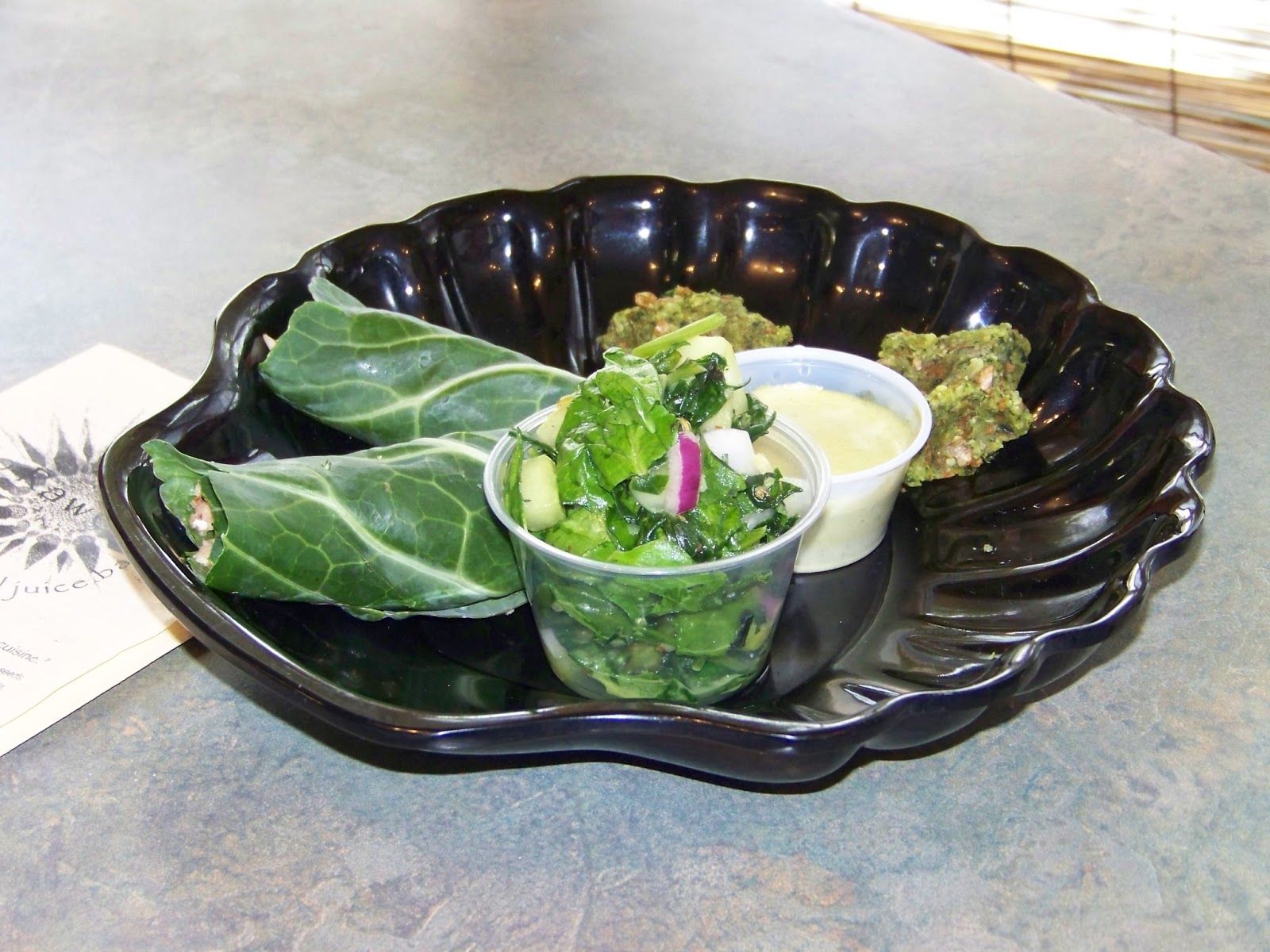
Served at the raw food prep class, clockwise from bottom center:  Crisp Cucumber Bruschetta Salad,"Dang Dude" Dolmas, Kale and Spinach "Star" Falafel with Green Goddess Dressing
From the Raw Food Prep Class:  Sticky Spiced Orange Yumcups

As always, Chef Areeya's Go Raw Prep Class was fun, entertaining, and informative.  Her next class is on July 21, 2013 at Go Raw Cafe Westside Location.  I highly recommend it!

The Go Raw Café also stocks all sorts off goodies for the raw foodist, including snacks, supplements and books.  You will not be disappointed by the selection. 

Take a few minutes to enjoy the art on display at the Go Raw Café and Juice Bar Westside.

They carry a large selection of locally-made raw snacks.


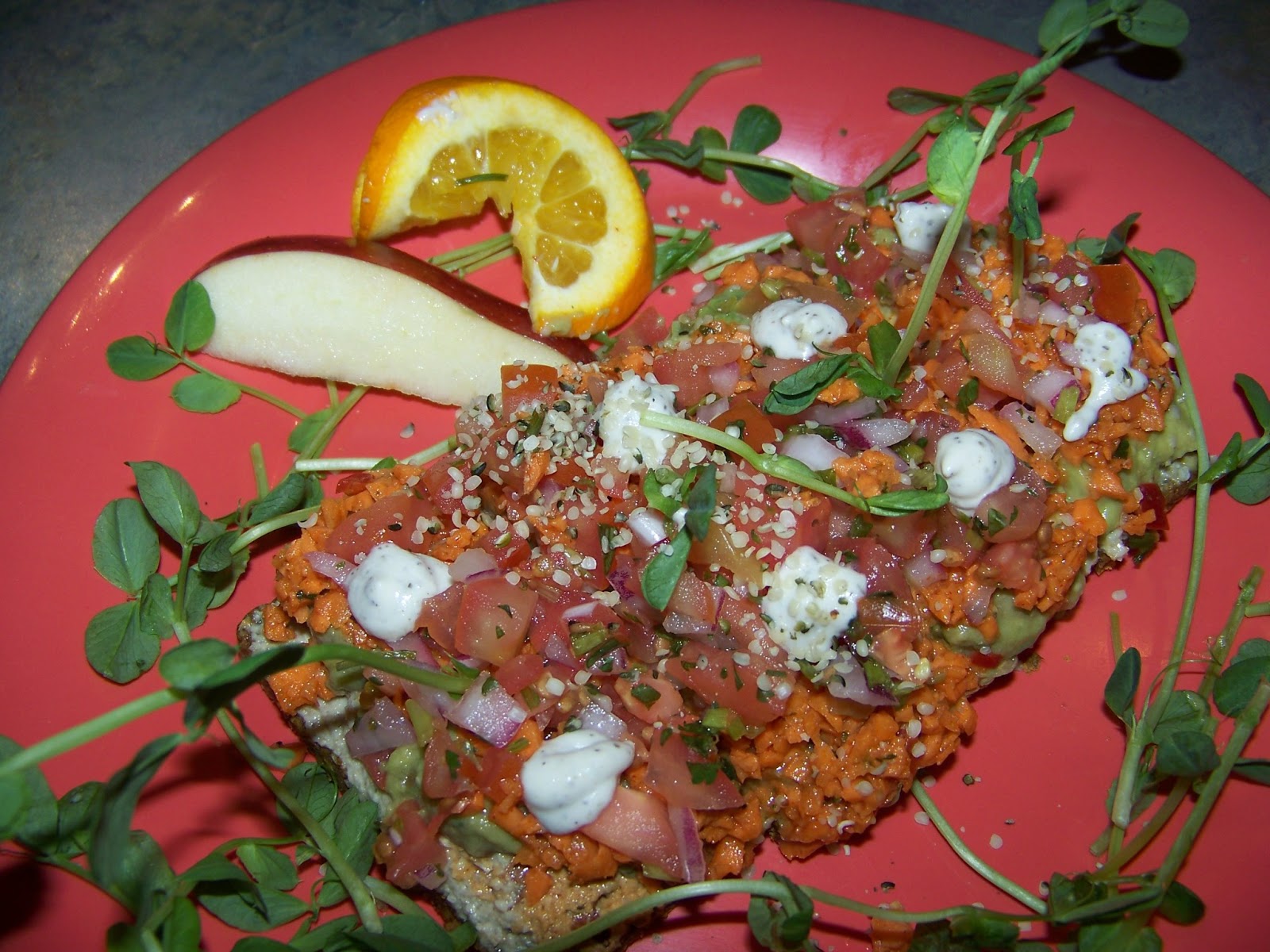
One of the things that sets The Go Raw Café Westside and The Go Raw Café Eastside apart  is the menu.  If you are in the mood for pizza or a burger you can find a delicious raw version.  More than a feast for your body, it's a feast for the eyes as well. 


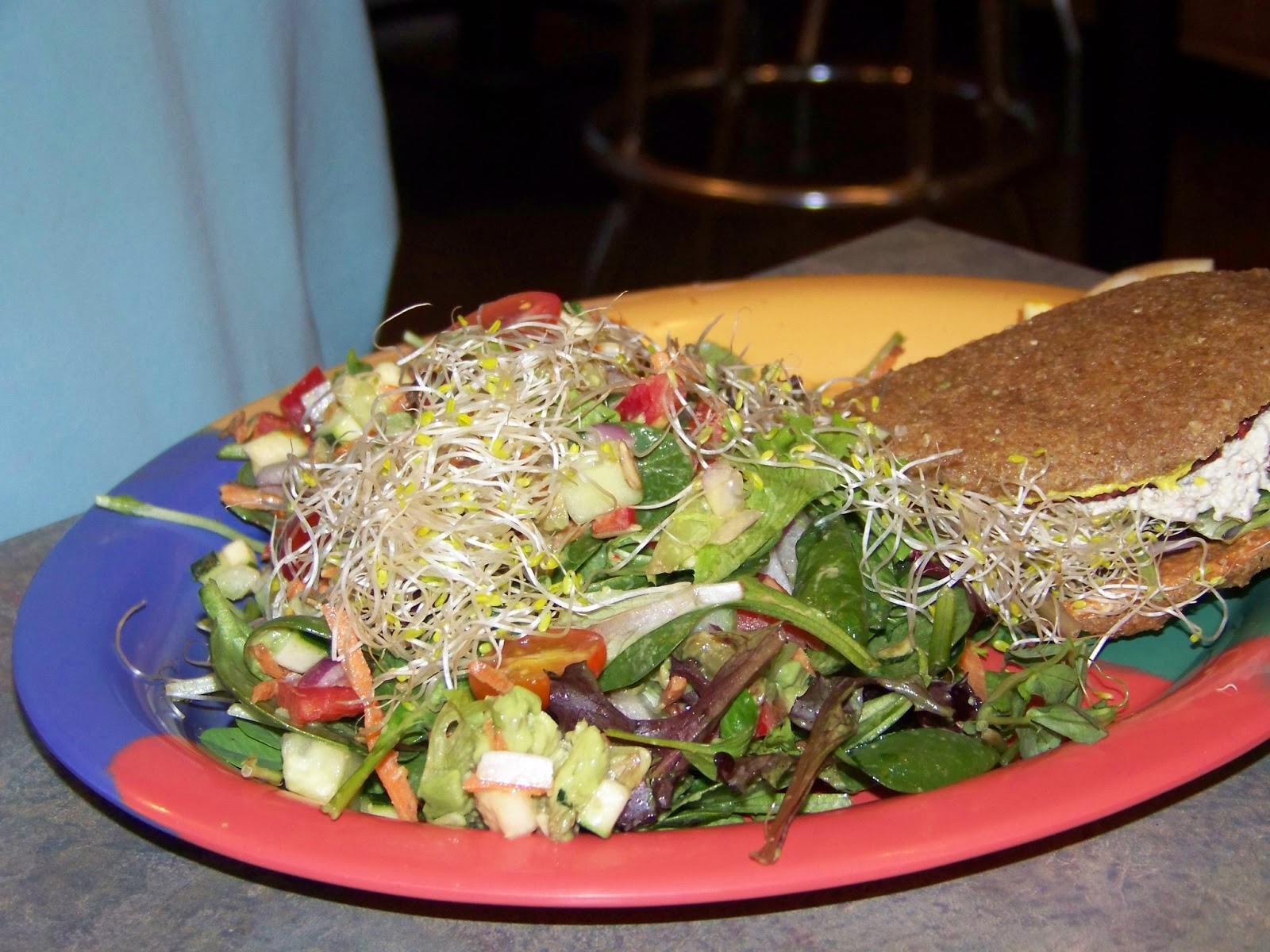
Over time, my family and I have tried everything on the menu, and everything is fresh, flavorful and fabulous.  My favorites are the "Salmon" Cakes w/ "Fries" & Veggies, and the Purple Burrito.  Our kids are completely nuts about the smoothies and the raw pizzas, and everyone in our family loves the Gimme The Beet Burger.  For people who are newcomers to raw food, I recommend that you ask your server to help you make a selection.
A gorgeous view of the lake just outside the Go Raw Café and Juice Bar Westside.

The small outdoor seating area at Go Raw Café  and Juice Bar Westside is a soothing place to sip a smoothie and relax.

More information about the Go Raw Café and Juice Bar can be found here: 

Thursday, June 27, 2013

FRawpachicareeno Take II


Superfood For The Ladies Version (And Good For The Guys Too)


1 cup raw hulless oats, sprouted and rinsed (It's okay to use toasted oat groats if you aren't 100% raw, but they won't sprout)
3 tbsp organic black strap molasses  (Omit if you are 100% raw)
3 tbsp Cafix or other chicory coffee substitute (For 100% raw, try using raw chicory)
4 tbs raw mequite powder
3 tsps raw maca powder
3 tbsp raw lucuma powder
1/2 cup raw cacao powder
3 tbsp ground flax seed
3 cups fresh raw spinach
3 frozen ripe bananas, (make sure there are brown spots on the peel) chopped

water and ice


Start with the oats.  Add just enough filtered water to cover the oats, (about one cup,) and blend in a high-speed blender until creamy.  This step is important.  If you add too much water at first, it may be more difficult to get the oats to a creamy consistency, especially if they are dried or if haven't been soaked or sprouted.  Gradually add about another cup of filtered water and the molasses.  I like to slowly add the additional water and molasses while the machine is on.


Turn off the machine and add the rest of the dry ingredients to the blender.  (I prefer to combine and mix them in a small bowl first, but it's not critical.)  Place the bananas and spinach on top of the dry ingredients.  This helps keep them from flying up and sticking to the inside of the blender when you turn the motor on.  Add another cup of water.  Fill the blender to the top with ice.  Blend until creamy.

Alternative method:  If your oats are dry and have the Vitamix blender container with the dry blade, you can also try grinding the oats first until they are a fine flour.  Mix them with the rest of your dry ingredients, then place the mixture in your wet container with an equal amount of water.  Gradually increase the blender speed and blend until the mixture is smooth.  Then proceed with the remaining ingredients.

Note:  If you don't have a high speed blender, you may be able to do this with a kitchen blender if you start with oat flour or instant oats rather than whole oats.  You may also need to start with a higher ratio of water to dry ingredients.

Makes three generous servings.

The good news:  This drink is packed with nutrition!  According to my calculations one serving contains at least 11 grams of protein.  It will keep you full all morning.  The oats are a great source of soluble fiber and protein, a source of B vitamins and minerals and is a great blood sugar stabilizer.  The blackstrap molasses is a source of potassium, iron and calcium.  Mesquite powder contains protein, potassium, iron, calcium and dietary fiber.  Maca root has been traditionally used used by Andean societies and is believed to be good for the endocrine system.  It is used to combat stress, fatigue and to improve the libido.  It contains some protein, calcium and iron.  Lucuma is an alternative sweetener that contains some fiber and protein, some B3 and antioxidants.  Raw cacao powder contains calcium, iron, and protein.  Ground flax seed is rich in Omega 3 fatty acids, fiber, and is high in phytochemicals, particularly lignans, which are believed to help balance female hormones and may help prevent Type 2 diabetes.   Raw spinach is packed with vitamins, minerals and protein.  Bananas are a rich source of potassium, vitamin C, and fiber.  According to a Japanese study, bananas with brown spots on the peel help fight cancer. 

The bad news:  This version made 3 tall servings - at over 550 calories each!  However, it made a terrific breakfast with some good staying power.   And no, you can't taste the spinach at all.

Yes, I know, I promised a lower calorie version of the original.  It's tough because all of the ingredients contain nutrients.  I might try eliminating the mesquite and lucuma, reduce the banana to half, reduce the black strap molasses by 2/3 and then substitute with some stevia.  Or not.

Wednesday, June 12, 2013

Bless Me Father, for I Have Sinned. . .

Dear Reader:

Sorry if the following is in poor taste.  But aren't you glad raw food isn't a religion?

"Bless me Father, for I have sinned.  It has been 3 weeks since my last confession.

I found some fish oil capsules in my kitchen that I bought before I saw the light, and they don't expire until next year, and I didn't want them to go to waste.  So I took them for the omega 3s..

And then we went to a social gathering, and the host said the vegetarian food was on platter "A" and the food with meat was on platter "B," but the platters got switched and I didn't know it until it was too late so I ate something with meat in it."

"My child, for your penance you must watch "Earthlings" again, and this time do not look away or cover your eyes.  And then for consuming the fish oil, you must watch "End of the Line."  Then go on a three day juice fast."

"Please forgive me for my transgressions."

"Now go and sin no more."


Thursday, June 6, 2013

FRawpachicareeno


FRawpachicoreeno.  Okay, so the name is kind of corny, but this thick, rich beverage reminds me of the drinks that people will wait in line to order - except in my opinion this is much better for your health. It's made with raw almond milk, roasted chicory, raw cacao, frozen bananas, dates, ground flax and black strap molasses.  It's every bit as decadent and delicious as the Standard American Diet (SAD) version.

Warning:  This is NOT a diet food!  It's not a weight loss food!  This is an example of the kind of high-raw food you can eat if you are NOT trying to lose weight!  But if you must indulge, compare this dairy and caffeine-free, whole-foods version to the fat and sugar load of the SAD version.  You'll find that in a side by side comparison with the SAD version, while it's higher in fat and calories per ounce, it's the "healthy" type fat, plus it has fiber, less sugar, and no cholesterol.  The bottled SAD version comes in a 9.5 oz. serving and contains 31 grams of sugar, fewer grams of protein, and no fiber.  This version is a much more generous serving size, and as an added bonus, it has some potassium, calcium, magnesium, phosphorus, iron, and additional vitamins and minerals.  In fact in my opinion, one 15 oz. glass of this beverage is a complete breakfast if it's part of an overall healthy diet.  If you wish to boost the nutrition even more, toss in a couple of handfuls of spinach.

If you choose to avoid roasted chicory, here is a source for raw chicory root.    I don't know how using raw chicory would change the taste, but according to my sources it's a better source of prebiotics than roasted chicory.

For chicory, I used Cafix Instant Beverage, which contains roasted barley, chicory, malt, figs, and red beet concentrate.  If you are gluten intolerant and would like to try the coffee-like flavor of roasted chicory without the barley, you can find it here.  Mountain Rose Herbs also carries dried beetroot powder, a pinch of which would be an excellent healthy addition to this beverage.  Or, simply add a small piece of fresh beet.

If you don't use cacao, you can probably substitute with carob.  In fact, you can probably omit cacao and carob altogether for a completely different flavor.   However some of the calcium, iron and antioxidants in this beverage are found in the cacao. For me personally, the cacao is the whole point of the drink!

For the almond milk, soak 1 cup of raw almonds overnight, rinse them and blend them with an equal amount of water in a high speed blender until creamy.  Add about 16 oz. of water and blend again.  Filter the mixture through a nut milk bag.  The milk is then used to make this beverage.  The pulp can be composted or reserved to make other recipes such as raw breads and crackers.  This might sound like a lot of work, but it only takes about five minutes tops to turn soaked almonds into almond milk, including cleanup.

The organic blackstrap molasses is not raw, and no raw version is available.  However, as a dietary supplement, it will enhance the coffee-like flavor of this beverage and add additional calcium, magnesium and iron, nutrients often needed in a vegan diet.

Note on the blackstrap molasses:   In my opinion, this should be organic.  The problem with non-organic black strap molasses is that most of the non-organic sugar found in the markets in the U.S. is likely to be GMO.  I'm willing to compromise and buy non-organic food when non-organic is not available or unaffordable, but this is not one of those times.  If it's not available in an organic form, I will not use it.

The ground flax seed adds creaminess and balances the omega 6 fatty acids in the almonds with additional omega 3 fatty acids.  Keep in mind that one serving of this beverage will not meet your requirement for omega 3 fatty acids for a day.  According to Dr. Michael Greger M.D., vegans need two tablespoons of ground flax seed each day in order to obtain enough Omega 3.

Currently I'm working on a more nutrient-dense version of this drink that is lower in calories and fat. I'll try to post it next week.  In the meantime, indulge a little!


FRawpachicoreeno

Four generous, creamy, sweet servings, of 15 oz. each, (the bottled serving size of a comparative beverage is 9.5 oz.) enough to satisfy even the strongest craving for a decadent beverage - and it's a bit better for you.

3-4 cups of almond milk made from 1 cup of soaked and rinsed raw almonds
4 tablespoons instant coffee substitute beverage (I used Cafix, see comments above for alternatives)
1/2 cup raw cacao powder  (substitute with raw carob if you don't use cacao)
1 tsp raw ground vanilla powder
3-4  pitted deglet noor dates, depending on preference
3-4 frozen bananas (about 2 cups)
4 tablespoons organic blackstrap molasses
1 tablespoon ground flaxseed
 ice

Blend everything but the ice and bananas into the almond milk.  A high speed blender like a VitaMix is best.  Chop the frozen bananas into small pieces and add to the blended mixture, then blend just until creamy.   Add ice to fill the blender and blend just until cold and smooth.  A few minutes or so after blending, the ground flax will be begin to thicken the drink.  Serve immediately.  


Serving Size 15 oz

Nutrition per serving

Calories 315
Total Fat   14 g
Saturated Fat  2 g
Monounsaturated fat 8 g
Polyunsaturated fat 3 g  
Trans Fat 0g
Omega 3 fatty acids  416 mg
Omega 6 fatty acids  2995 mg
Cholesterol  0 mg
Sodium  1 mg
Total Carbohydrate 40 g
Dietary Fiber 10 g
Sugars 28 g
Protein 8 g